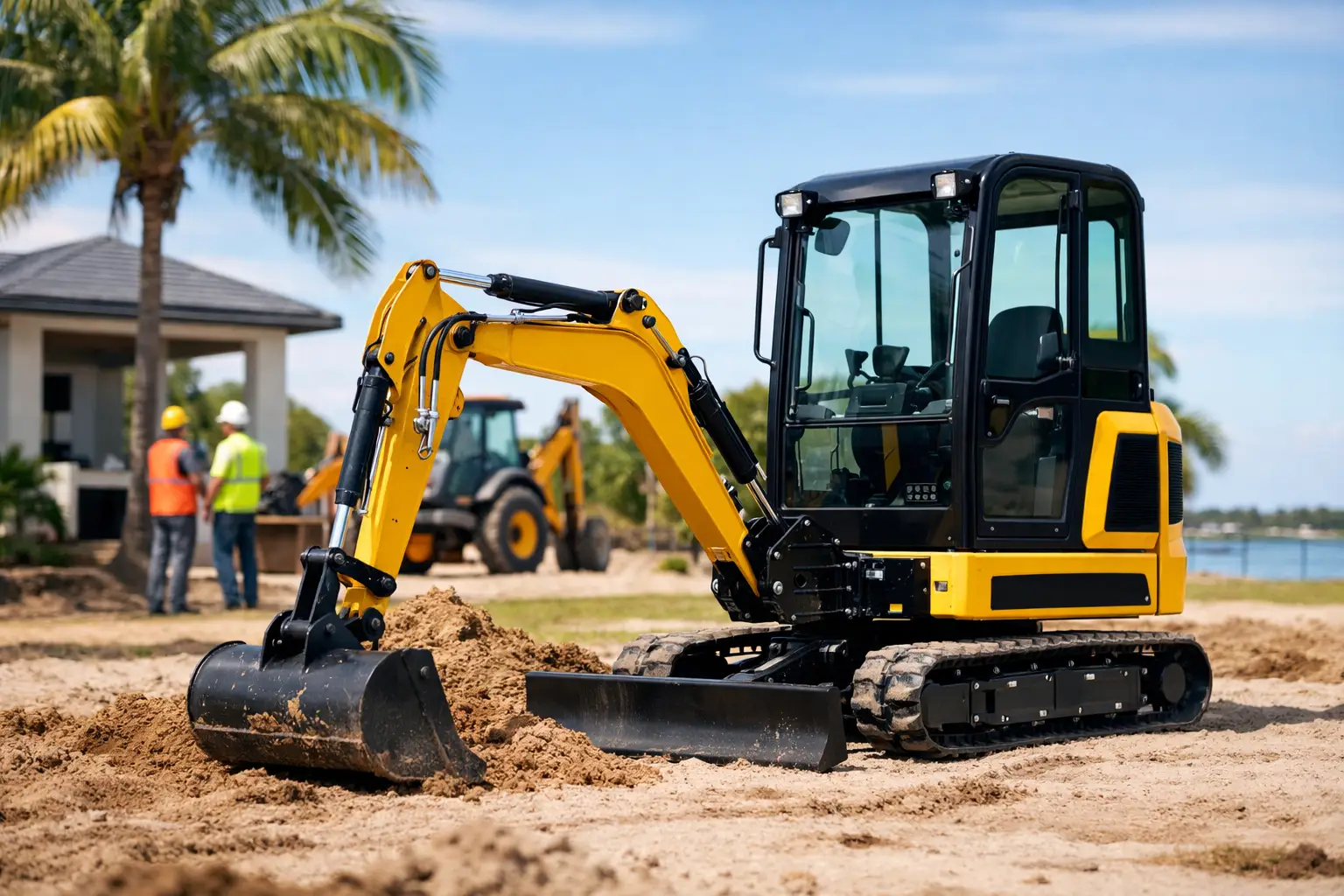
A compact excavator is often selected for the jobs it can physically reach. The JCB 19C-1E adds another factor: whether the machine can work where diesel exhaust and engine noise create a problem. This JCB 19C-1E review looks at what the electric mini excavator delivers in the field, where it fits best, and what a buyer should consider before putting one into a Florida fleet.
At roughly 4,200 pounds operating weight, the 19C-1E is a serious compact machine rather than a novelty electric unit. It is sized for trenching, landscape construction, utility work, interior demolition, municipal maintenance, and site work where access is limited. Its real advantage is simple: it performs excavator work without tailpipe emissions at the point of use.
What the JCB 19C-1E Is Built to Do
The 19C-1E is a conventional-tailswing compact excavator powered by a lithium-ion battery system instead of a diesel engine. It is designed around the same daily requirements that drive a diesel mini excavator purchase: dig, lift, load, grade, reposition, and repeat in a confined work area.
For a contractor, electric power is not automatically the right answer for every project. On an open subdivision site running long shifts away from dependable power, a diesel excavator may remain the more practical choice. But on a night utility repair, inside a building, beside occupied homes, or on a campus with strict noise controls, an electric excavator can solve an operational problem that a conventional machine cannot.
The machine’s compact footprint is central to its value. It can get through restricted access points and work close to structures, fences, landscaped areas, and existing utilities. Conventional tailswing gives the operator a stable working platform and useful lift capability for the machine class, but it also means the counterweight must be managed carefully when swinging near walls or traffic.
JCB 19C-1E Review: Key Working Numbers
Specifications should guide the purchase, not replace a jobsite assessment. The 19C-1E brings the dimensions and digging capability expected from a 1.9-ton mini excavator.
Its operating weight is approximately 4,193 pounds, providing enough machine mass for productive trenching while remaining manageable for transport. Maximum digging depth is about 8 feet 5 inches, and maximum dump height is about 8 feet 8 inches. Those figures suit common utility laterals, irrigation installation, drainage work, footings, landscape excavation, and loading into appropriately sized trucks or trailers.
Battery capacity is approximately 19.8 kWh. JCB positions the machine for a typical full work shift between charges, but actual runtime depends on the work. Continuous hard digging in compacted material, frequent high-flow attachment use, travel over uneven ground, and aggressive hydraulic operation consume energy faster than light finish work or intermittent digging.
That is why a serious buying decision starts with the duty cycle. A crew that runs an excavator steadily all day on deep trenching needs to plan charging and evaluate whether the work can be completed within the available battery window. A crew that alternates excavation with layout, pipe installation, material handling, and labor support may find that the 19C-1E fits naturally into a full shift.
Charging Needs to Be Part of the Plan
The electric advantage depends on access to power. The 19C-1E can be charged from common jobsite electrical supplies, with faster charging available where higher-voltage power is accessible. Charging overnight is the straightforward approach for many contractors, especially when the machine returns to a yard or secured site each evening.
Before purchasing, confirm the electrical service at the yard, typical project locations, and any fleet charging infrastructure. A machine that spends each night near a compatible power source is easier to manage than one that moves between remote jobsites with no reliable electricity. This is less about the excavator itself and more about how the operation is organized.
Where Electric Power Pays Off
The strongest case for the 19C-1E is not simply lower noise. It is access to work that may be restricted, delayed, or unpleasant with a diesel machine. With no diesel exhaust at the work area, crews can work in enclosed spaces with appropriate overall ventilation and jobsite safety controls. The quiet operation also makes communication easier around the machine and reduces disruption near residents, schools, hospitals, hotels, and commercial tenants.
Interior demolition is a clear example. A compact excavator may be needed to remove slab, break out material, or handle debris after structural and access conditions have been reviewed. Eliminating engine emissions inside the building removes one major barrier to using powered equipment in that environment.
Municipal departments and utility crews can also benefit during work near public spaces. A quieter excavator is valuable for early-morning maintenance, park work, roadside repairs, and work close to occupied facilities. Landscapers and hardscape contractors may see similar benefits when working in established neighborhoods where noise complaints can slow a crew down.
The trade-off is that electric power requires stronger planning around charging. The 19C-1E is not meant to replace every diesel excavator in a fleet. It is best used as a targeted machine for work where low noise, point-of-use zero emissions, and compact access carry real value.
Operator Controls, Safety, and Daily Use
A mini excavator has to be easy to place precisely. The 19C-1E retains the familiar control layout and operating feel expected by experienced compact-equipment operators, which helps reduce the learning curve when moving from a diesel mini. Smooth hydraulic control matters when trenching around utilities, setting pipe, grading close to a foundation, or working beside finished hardscape.
Electric operation also changes the work environment for the operator and ground crew. Without diesel engine noise, operators can better hear spotters, alarms, and nearby activity. That does not replace standard jobsite procedures. A quiet machine still requires clear exclusion zones, a competent spotter where visibility is limited, and disciplined communication around swing areas and travel paths.
Daily checks remain part of the job. Inspect the undercarriage, tracks, bucket and linkage, hydraulic hoses, pins, attachment connections, and overall machine condition. Electric does not mean maintenance-free. It means the powertrain maintenance routine differs from diesel equipment, with no engine oil changes, diesel fuel system service, or exhaust aftertreatment requirements.
Attachments and Productivity Considerations
The 19C-1E becomes more useful when matched with the attachments that dominate a contractor’s work. A trenching bucket may be the daily tool for utility work, while a grading bucket supports finish work, backfill, and site cleanup. A hydraulic breaker can make sense for selective demolition, though the attachment’s energy demand must be considered when estimating runtime.
The right attachment does more than broaden capability. It can eliminate hand labor and reduce machine repositioning. However, buyers should avoid judging attachment suitability only by physical fit. Confirm hydraulic requirements, machine configuration, coupler compatibility, and expected duty cycle before committing to an attachment package.
Transport is another practical consideration. At this weight class, the 19C-1E can be trailered efficiently with the proper trailer, tow vehicle, tiedown equipment, and allowance for buckets or attachments. Verify the complete transport weight rather than relying on the base machine figure. Staying within tow ratings and trailer capacity protects crews, equipment, and schedules.
Who Should Buy the JCB 19C-1E?
The best buyer is a contractor or fleet manager with recurring work that benefits from quiet, zero-emission operation and has predictable charging access. It can be a strong fit for interior construction, municipalities, utilities, property maintenance, landscaping, campus work, and contractors pursuing projects with environmental or noise requirements.
It may be less suitable as the only excavator for a company that regularly performs extended, high-load work in remote locations. In that situation, a diesel mini excavator provides refueling flexibility that is hard to ignore. Many operations will get the most value by pairing an electric excavator with diesel units rather than treating the decision as all-or-nothing.
For Northeast Florida contractors evaluating the machine, BRIGGS | JCB can help compare the 19C-1E against diesel compact excavators based on digging requirements, access conditions, transport needs, attachments, and available charging. The right answer comes from matching the machine to the work your crew performs most often.
The JCB 19C-1E makes the most sense when electric capability creates a practical jobsite advantage, not just a different power source. If quieter operation, no point-of-use emissions, and compact digging performance help your team win and complete more work, it is a machine worth putting on the schedule.