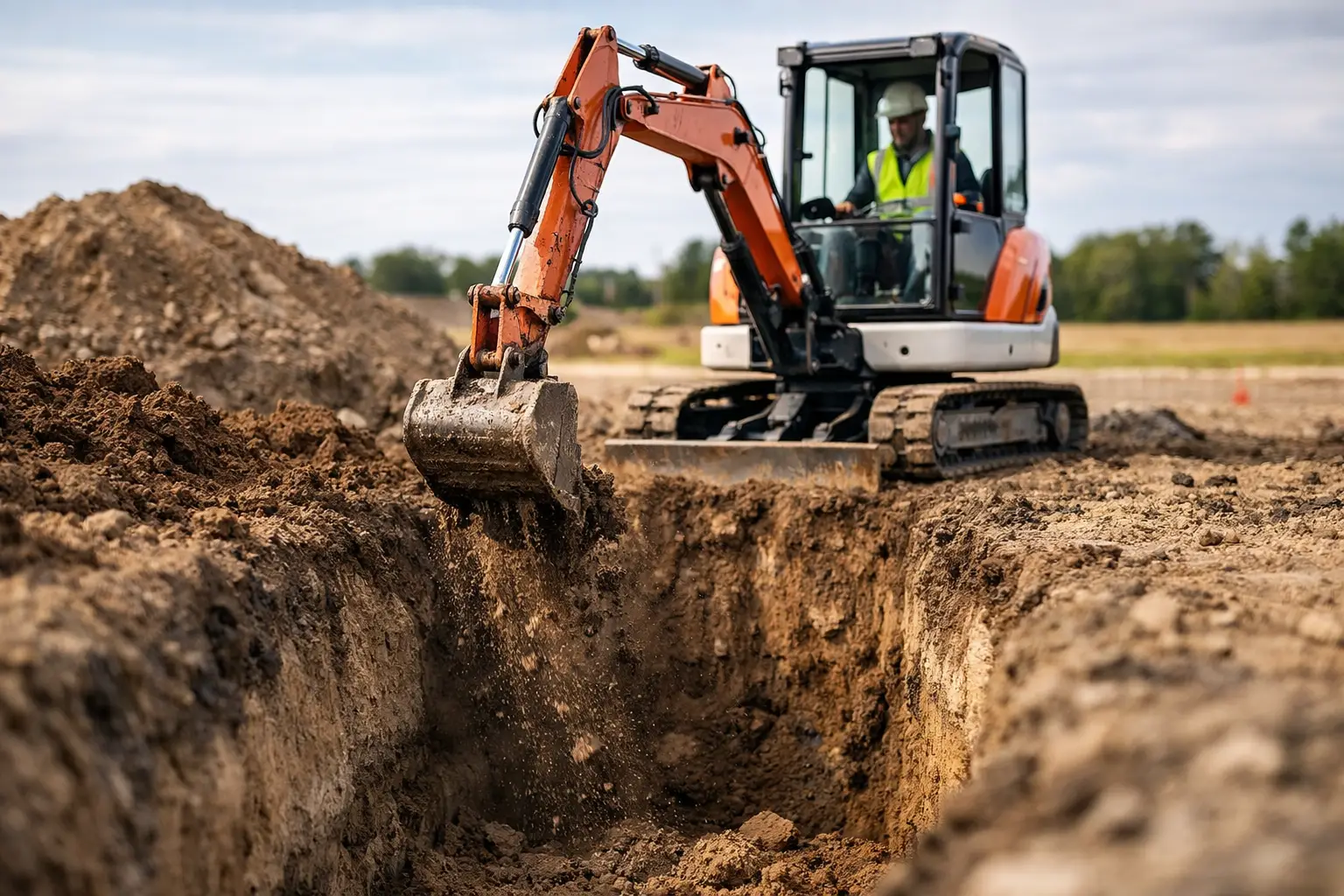
A trench that needs to reach 8 feet is not an 8-foot-machine decision. Bucket position, ground conditions, trench grade, required working room, and the machine’s reach at depth all affect whether the excavator can complete the work efficiently. Mini excavator digging depth is a core specification, but it only becomes useful when it is matched to the actual conditions of the job.
For a contractor, that match affects more than whether the bucket touches the bottom of the trench. It affects cycle times, machine placement, spoil management, transport requirements, and whether the crew can keep moving without bringing in a larger machine. The right compact excavator provides enough depth and reach to work productively while still fitting through gates, around structures, and onto the trailer you already use.
What Mini Excavator Digging Depth Actually Measures
Maximum digging depth is the vertical distance the bucket can reach below ground level under the manufacturer’s specified test position. It is a valuable starting point for comparing machines, but it is not a promise that every trench can be dug to that depth in every direction or condition.
A machine may achieve its published maximum depth with the boom, arm, and bucket positioned at a particular angle. In the field, the operator also needs room to maintain the intended trench line, clean the bottom, shape sidewalls where required, and avoid repeatedly repositioning the machine. If a utility trench is close to the machine’s maximum rated depth, productivity can fall off quickly as the excavator works at the edge of its geometry.
That is why buyers should consider maximum digging depth alongside reach at ground level, maximum digging reach, bucket breakout force, arm crowd force, and machine stability. A spec sheet tells you what a machine can reach. The jobsite tells you how comfortably it can do the work.
Start With the Finished Trench, Not the Machine
Before comparing excavators, define the deepest point the crew must excavate, not simply the typical depth. A drainage run may average 3 feet but require a deeper connection at a catch basin. A utility installation may include transitions, crossings, or service tie-ins that extend below the main trench elevation.
Add a reasonable operating margin instead of selecting a machine whose maximum depth exactly equals the required depth. That margin gives the operator room to keep the boom and arm in a productive position. It also accounts for uneven terrain, a machine working from a slightly elevated setup area, and the need to finish the trench bottom accurately.
For shallow landscaping drainage, irrigation, footings, and light site work, a smaller mini excavator may provide the compact access and towability that matters most. For deeper utility, septic, stormwater, and commercial site-development work, additional dig depth and reach can save significant time over the life of the project. The decision depends on the work your crew performs repeatedly, not the occasional job that could be subcontracted or handled with a rental.
Account for Ground Elevation and Setup Position
Dig depth is measured from the ground beneath the machine. If the excavator is positioned on a berm, beside a curb, or on ground that sits higher than the trench line, the effective depth available below the trench grade is reduced.
This is common on Florida jobsites with drainage swales, retention areas, new roadwork, and uneven clearing work. A crew may have enough reach on level ground but lose valuable capacity when it has to stay back from a soft edge or operate from a built-up access lane. Looking at the site layout before selecting the machine prevents this kind of surprise.
Depth Is Only One Part of Trenching Productivity
A deeper machine is not automatically the better trenching machine. If the excavator is too large for the access route, cannot swing safely beside a building, or requires an oversized transport setup, its extra depth may not improve the job.
Tail swing is a practical example. A zero-tailswing compact excavator can work close to walls, traffic barriers, fencing, and landscaped areas with less counterweight exposure during rotation. That can be more valuable than a few additional inches of digging depth on an urban utility repair or residential backyard project. Conventional-tailswing machines may offer advantages in other applications, particularly where jobsite room is available and stability is a priority.
Bucket selection also changes the result. A narrow trenching bucket is efficient for utility work because it removes less material and creates a trench closer to the required width. A wider bucket may be needed for footings, drainage structures, or cleanup, but it can increase resistance and make precise deep digging slower. The bucket should match the trench specification and soil conditions, not simply what happens to be on the machine.
In hard clay, compacted fill, roots, or broken concrete, breakout force matters as much as depth. A machine that reaches the target elevation but struggles to penetrate the material will not maintain production. For demolition and tough ground, hydraulic flow and attachment capability may deserve equal weight in the buying decision.
Compare Depth With Reach, Dump Height, and Weight
When reviewing a mini excavator, treat the specification sheet as a working set of measurements. Digging depth answers one question. The rest of the machine determines how well it fits the operation.
Operating weight affects stability, ground pressure, transport planning, and lifting capability. A lighter compact excavator may be easier to tow and better suited to finished surfaces or restricted access. A heavier machine generally offers a stronger, more planted working platform for deeper excavation, material handling, and demanding attachments. Neither is automatically right. The better choice is the one that supports the work without creating transport or access problems.
Maximum dumping height is also easy to overlook. If excavated material must be loaded into a dump truck, over a wall, or into a hopper, the machine needs sufficient height at a practical working radius. Otherwise, the crew may have to stockpile spoil, relocate it with another machine, and handle the same material twice.
For buyers comparing JCB compact excavators, the range from smaller machines such as the 18Z-1 to larger compact models such as the 100C-2 gives crews room to balance tight-access performance against deeper excavation capability. The useful comparison is not simply smallest versus largest. It is the model that covers your required trench depth, reach, lifting needs, and daily transport plan with enough margin to work efficiently.
Ask These Questions Before You Request a Quote
A productive equipment conversation starts with job details. Bring the expected trench depth, trench width, material type, access limitations, and transport setup to the table. Also identify whether the machine will primarily dig, load spoil, set structures, run a breaker, grade, or perform several tasks in one day.
Consider how often the work approaches the machine’s maximum depth. If deep digging is rare, a smaller excavator may be the better ownership choice, with a larger unit rented for occasional specialized work. If crews regularly install deep utilities or work in commercial development, buying enough depth and reach up front can reduce cycle time on every project.
Think about operator conditions, too. A comfortable cab, clear visibility, responsive controls, and stable footing help the operator maintain accuracy through a long day of trenching. Those factors are not separate from productivity. They are part of how consistently the machine performs when the work requires precision near existing utilities, structures, or grade stakes.
Use Published Depth as a Planning Number
Published mini excavator digging depth gives you a sound way to narrow the field, especially when comparing machines in a similar size class. Use it to establish a minimum requirement, then verify how the machine’s reach, tail swing, breakout force, operating weight, and transport needs fit your work.
The best compact excavator is not the one with the largest number on the brochure. It is the one that gets to the trench, reaches the required grade with room to work, handles the material in front of it, and is ready to do the same job again tomorrow.