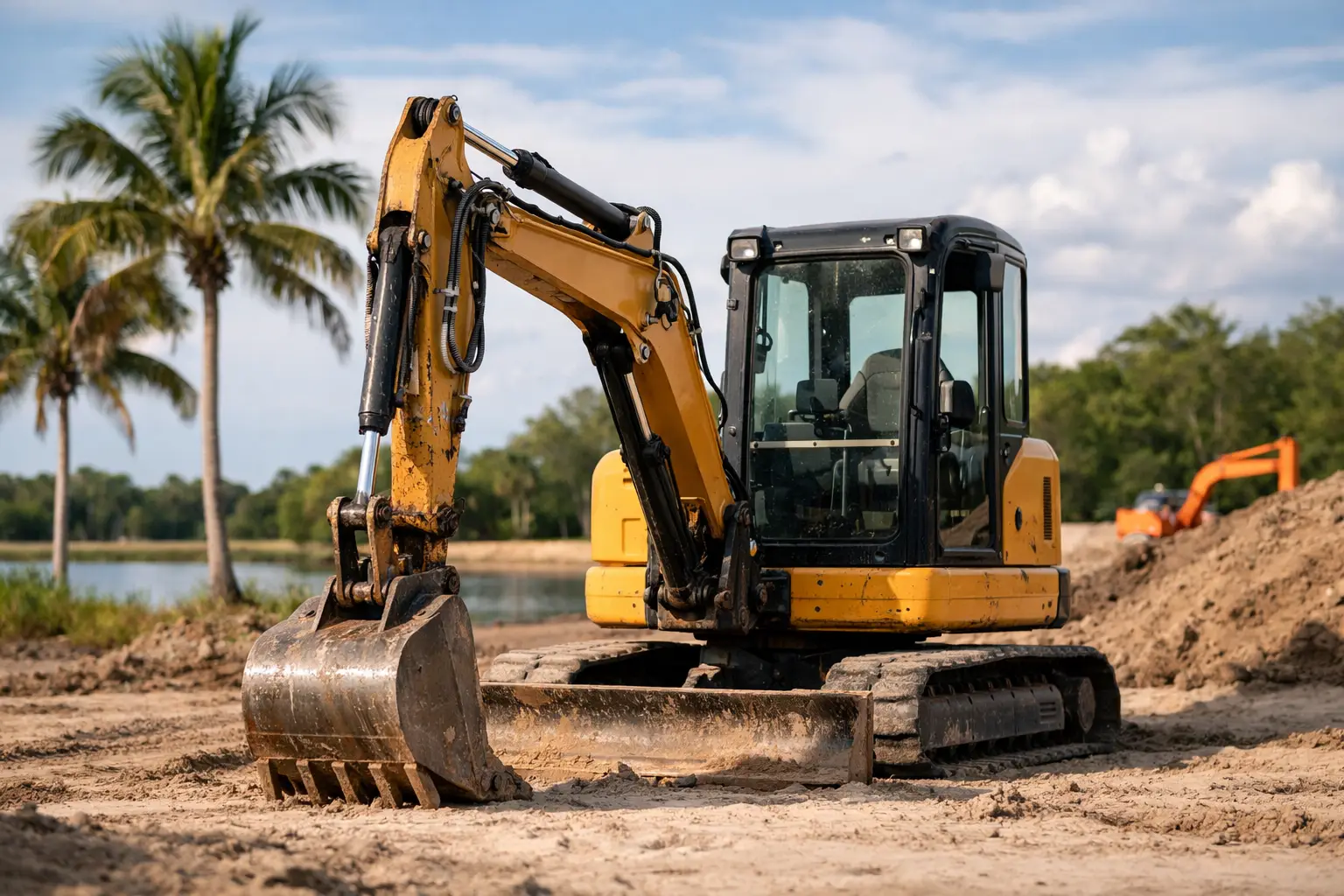
A lower purchase price only helps if the machine can report to work Monday morning and keep producing. Used mini excavators can be a strong buy for Florida contractors, utility crews, landscapers, and municipalities, but the right choice comes down to more than the hour meter. Machine condition, attachment history, transport requirements, dig depth, and local support all affect whether a used excavator saves money or creates downtime.
A compact excavator earns its keep by doing work larger equipment cannot reach efficiently. It can trench beside occupied buildings, shape drainage on tight lots, load trucks in restricted areas, and work around utilities with better control. The goal is not to buy the lowest-priced machine. The goal is to buy a machine that fits the jobs you perform most often and has enough remaining service life to support your schedule.
Start With the Work, Not the Price Tag
Before comparing listings, define the work the excavator must handle. A contractor installing irrigation and drainage lines has different requirements than a site crew loading spoils, a demolition company sorting debris, or a utility crew working in congested rights-of-way. Operating weight, breakout force, digging depth, reach, and attachment capability should all relate directly to the work.
For light residential work, landscaping, fence foundations, and small utility repairs, a smaller excavator may provide the access and towability that matter most. A compact machine in the range of the JCB 18Z-1, with an operating weight starting at 3,649 pounds, can be easier to move between jobs and more practical in backyards or established sites.
For deeper trenching, heavier bucket loads, demolition work, or steady production on commercial projects, moving up in size can reduce cycle times and improve stability. The trade-off is transport weight, ground pressure, and the room required to work safely. A machine that is oversized for the site may spend more time being repositioned than digging.
Match Tailswing to the Jobsite
Tailswing configuration is one of the first decisions to make. Zero-tailswing mini excavators keep the counterweight within the track width or close to it as the house rotates. That makes them a practical choice when working next to buildings, traffic lanes, trees, fences, and other fixed obstacles.
Conventional-tailswing machines can offer a different balance of lift capacity, reach, and stability. They may be the better fit where the work area is open and production is the priority. Neither configuration is automatically better. A zero-tailswing model can prevent costly contact damage in confined areas, while a conventional-tail machine may make more sense on open site-development work.
What to Inspect on Used Mini Excavators
Hours are useful, but they are only one part of the condition story. A well-maintained excavator with higher hours can be a better operating purchase than a low-hour machine that has been poorly serviced, run with contaminated fluids, or used hard with a breaker.
Start with the undercarriage. Examine track condition, sprockets, idlers, rollers, track tension, and signs of uneven wear. Undercarriage repairs can be a significant expense, especially when several components are near the end of their useful life. Look for damaged track frames, loose hardware, or excessive movement at the rollers and idlers.
Then inspect the boom, arm, bucket linkage, and swing area. Pins and bushings should not show excessive play. Check welds carefully for repairs or cracks, particularly around high-stress areas such as the boom foot, stick base, bucket linkage, and blade mounts. A repair is not always a reason to walk away, but it should be evaluated against the machine’s use history and expected workload.
Hydraulics deserve close attention. Start the machine cold when possible, operate every function, and allow the oil to reach working temperature. Watch for slow or jerky cylinder movement, drifting, weak travel motors, leaking hoses, and unusual pump noise. Test auxiliary hydraulic circuits if you plan to run a thumb, auger, breaker, mower, or other attachment. An excavator that looks clean but has weak hydraulic performance is not ready for productive field use.
The cab or canopy also matters. Inspect controls, seat condition, display functions, safety interlocks, lights, travel pedals, and visibility. Operator comfort is not a cosmetic feature. When a crew member can work accurately through a full shift with good sightlines and responsive controls, trench quality and production improve.
Ask for Service History and Ownership Details
Documentation builds buyer confidence. Request maintenance records, repair invoices, inspection reports, and any available machine history. Regular oil and filter changes, hydraulic service, cooling-system maintenance, and documented repairs tell you far more than a fresh coat of paint.
Ask how the excavator was used. A machine that spent most of its life digging utility trenches may show different wear than one that ran a hydraulic breaker in demolition. Ask whether it was part of a rental fleet, owner-operated, or used by a larger contractor. There is no single deal-breaker in those answers, but the information helps set realistic expectations for pins, hydraulics, attachments, and cosmetic wear.
Also confirm that the serial number, safety decals, manuals, keys, and included attachments are accounted for. If the unit has a quick coupler, verify what bucket sizes or tools are included and whether they match your current fleet. A low purchase price can disappear quickly when the machine needs a coupler, bucket, thumb, trailer upgrades, and transport equipment before it can work.
Size the Machine for Transport and Production
A mini excavator should fit the entire operation, not just the hole you need to dig. Consider trailer capacity, truck ratings, tie-down requirements, permits, and the time your crew spends mobilizing. The right machine is one that can arrive safely, unload efficiently, and begin work without creating a transport bottleneck.
Digging depth and dump height should be checked against actual job requirements. If your typical utility trench is six feet deep, buying a machine that barely reaches that depth leaves little margin for grade changes or uneven terrain. If you regularly load high-sided trucks or dumpsters, confirm dump height and reach at the required loading position.
For larger compact-excavator needs, machines such as the JCB 100C-2, with an operating weight up to 21,385 pounds, bring more capability for demanding excavation and material-handling work. That added size can improve production, but it requires the correct trailer, tow vehicle, access route, and working area.
Do Not Overlook Electric Options
Electric mini excavators may fit indoor demolition, municipal work, and jobs near noise-sensitive areas where exhaust and sound restrictions affect operating hours. They are not the answer for every fleet. Charging access, runtime, duty cycle, and work location need to be evaluated carefully. But for the right application, an electric excavator can open work opportunities that a diesel machine cannot serve as easily.
Budget for Ownership, Not Just Acquisition
The purchase price is only the opening number. Build a working budget that includes insurance, transport, preventive maintenance, wear parts, fuel or charging, attachments, and likely repairs. If financing is part of the plan, structure the payment around the hours the machine will realistically produce each month, not an optimistic forecast.
A used excavator that is priced slightly higher but inspected, serviced, and supported by a local dealer can protect uptime better than an unknown private-sale machine. That matters when a crew, truck, and project schedule are waiting on one compact excavator to perform.
BRIGGS | JCB can help buyers compare used options against the JCB compact range based on operating weight, tailswing, digging requirements, and the equipment already in their fleet. A clear machine specification and honest condition review make it easier to purchase with confidence.
The best used mini excavator is not necessarily the newest, smallest, or least expensive unit available. It is the machine with the right reach, power, condition, and support to finish your normal work safely and keep moving when the next job is ready.