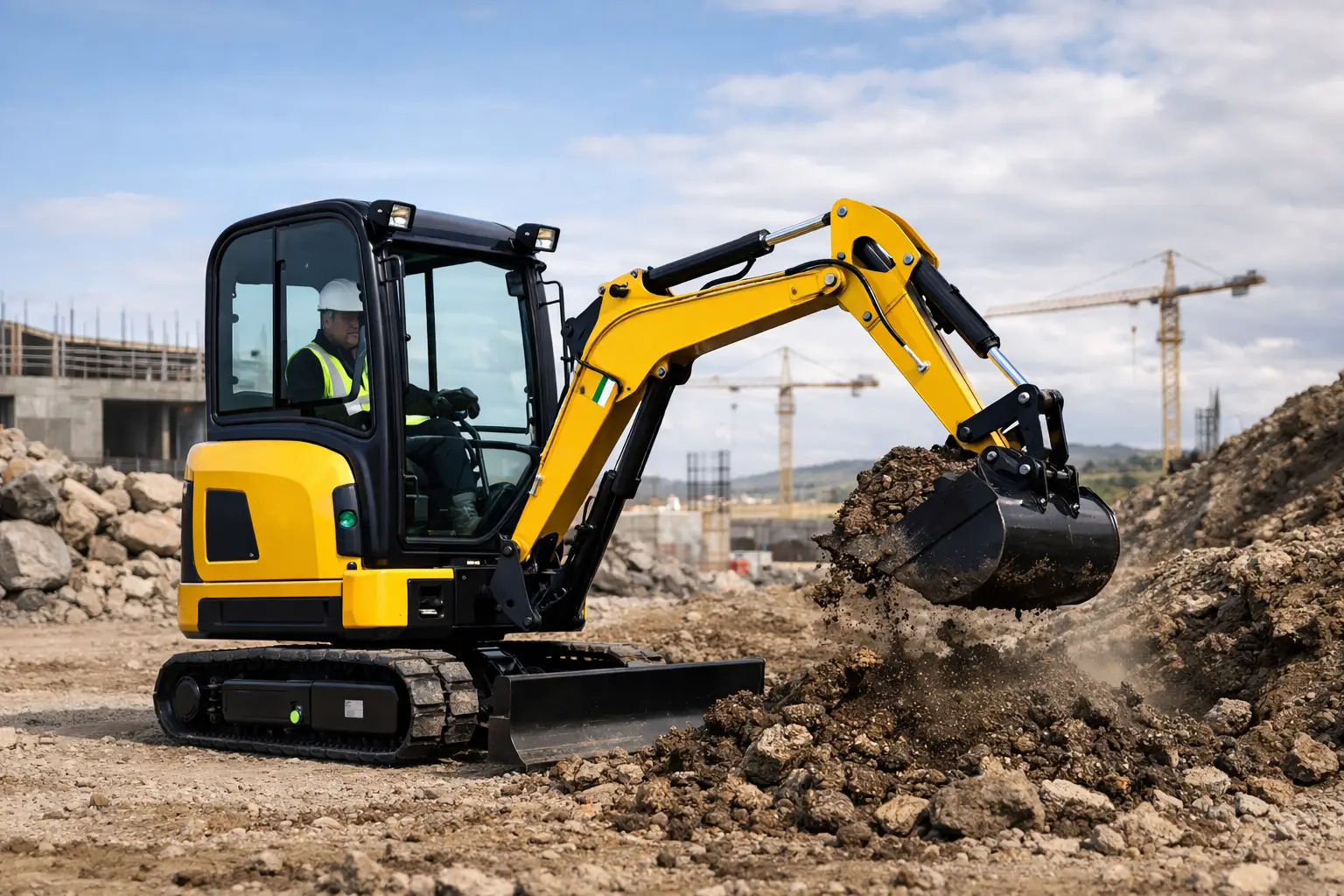
A diesel mini excavator can be the wrong machine before the bucket ever hits the ground. Indoor demolition, hospital expansions, utility work near occupied buildings, and overnight municipal projects all put pressure on noise, exhaust, and access. The JCB 19C-1E electric excavator gives contractors a compact digging machine built for those conditions without giving up the jobsite control expected from a 1.9-ton excavator.
This is not an electric machine chosen just for appearances. It is a practical option when emissions restrictions, enclosed work areas, or noise limits can slow a diesel-powered crew down. For the right workload, the 19C-1E can keep excavation, trenching, demolition, and material handling moving while helping crews work where internal-combustion equipment may require extra ventilation, restricted operating hours, or additional approvals.
Where the JCB 19C-1E electric excavator earns its place
The 19C-1E is best matched to compact jobsites where space matters as much as digging performance. Its conventional-tailswing layout gives the machine a stable working stance, while its compact size helps operators work around foundations, walls, utilities, and staged materials. It is well suited to contractors who need a machine that can travel through restricted access points and then perform productive digging once it reaches the work zone.
Indoor construction and demolition are obvious applications. Removing slab, digging for interior utilities, breaking out concrete, and handling debris inside warehouses or commercial buildings can create a difficult operating environment for diesel equipment. With no exhaust emissions at the point of use and substantially lower operating noise, an electric excavator can reduce the operational obstacles around occupied or enclosed spaces.
The same advantage applies outdoors. Crews working near schools, healthcare facilities, hotels, apartment buildings, and retail locations often need to limit disruption. Municipal maintenance work can also require quieter equipment for early-morning or night operations. In these settings, low noise is not a convenience. It can determine whether a crew can work during the available window.
Electric power is not automatically the right answer for every project. A contractor running long, remote shifts with no dependable charging plan may be better served by a diesel mini excavator. The 19C-1E makes the most sense when the work cycle, location, and charging access are planned together.
Electric power that still works like an excavator
The key question for an equipment buyer is straightforward: can the machine perform the work, not just meet the site requirement? The JCB 19C-1E is designed to deliver familiar excavator operation, including smooth hydraulic control for trenching, grading, loading, and attachment work. Operators can focus on bucket placement and cycle time instead of adapting to an unfamiliar machine concept.
In the 1.9-ton class, machine balance matters. A compact excavator needs enough working weight and hydraulic performance to dig accurately, load efficiently, and maintain control on uneven ground, yet it also has to be transportable and easy to position. The 19C-1E is built around that middle ground. Published machine specifications should be reviewed for the exact configuration, but buyers should expect a compact package with digging capability suited to utility trenches, footings, drainage work, landscaping, and confined demolition tasks.
Electric drive also changes the operator environment. Lower sound levels can make communication easier around the machine, particularly where a spotter, laborer, or utility crew is working close by. Less engine vibration and no diesel exhaust around the operating area can improve day-to-day comfort during interior and restricted-site work. Those gains do not replace safe operating practices, but they can make a long shift easier on the crew.
Quiet operation is a scheduling tool
Noise limits are often treated as a jobsite inconvenience until they affect production. A machine that cannot operate during certain hours leaves excavation work waiting on a narrow daytime window. The 19C-1E gives contractors another option when a project calls for reduced noise near neighbors, tenants, patients, students, or customers.
That does not mean the machine is silent. Bucket contact, tracks, hydraulic functions, demolition attachments, and material movement still create jobsite noise. But removing the diesel engine from the equation can make a meaningful difference where sound control is part of the work plan.
Zero tailpipe emissions support enclosed work
For interior operations, no tailpipe emissions is a major practical benefit. Crews may still need to manage dust, ventilation, concrete silica, attachment noise, and other site hazards, but they are not adding diesel exhaust to the work area. That can simplify planning for renovation contractors and facility managers working inside buildings that must remain partially occupied.
It also gives bidders a stronger equipment option when project specifications call for lower-emission equipment. The machine should be presented as part of a complete site plan, not as a substitute for ventilation, air-quality controls, or proper supervision.
Match the charging plan to the work plan
Battery-electric equipment requires a different kind of readiness check. Fuel delivery is replaced by charging availability, electrical service, and shift planning. Before selecting the 19C-1E, buyers should identify where the machine will charge, what power is available at the site or yard, and how charging fits between operating periods.
For many contractors, overnight charging at a secure yard is the cleanest approach. The machine arrives with a full charge for a defined shift, then returns to charge after work. Other jobs may support charging during breaks, between phases, or while crews complete layout, formwork, utility connections, or cleanup. The right plan depends on actual machine hours, attachment demand, ambient conditions, and how hard the excavator is worked.
A charging plan should account for more than the excavator. If temporary power is already being used for lighting, tools, pumps, or site offices, the available electrical capacity needs to be confirmed before the machine arrives. This is a field decision, not paperwork. A productive electric excavator needs dependable power at the time and place the work requires it.
What to compare before you request a quote
A purchase decision should begin with the job, then move to specifications. Compare the 19C-1E against the required dig depth, reach, dump height, lift needs, attachment use, access width, and transport setup. A compact machine that fits through the gate but cannot safely handle the planned load is not the right fit.
Use these four questions to narrow the decision:
- Can the machine complete the planned digging and loading work within its required reach, depth, and lift limits?
- Does the jobsite have a reliable charging location that supports the crew’s operating schedule?
- Will lower noise and zero tailpipe emissions create a real scheduling, access, or compliance advantage?
- Does conventional tailswing provide the needed stability, or does the site require a zero-tailswing excavator instead?
Operators should also consider the attachment package. A bucket may cover routine trenching and cleanup, but demolition, grading, material handling, and specialty utility work can require different couplers or hydraulic attachments. Confirm auxiliary hydraulic needs and attachment compatibility before the machine is assigned to a recurring task.
A practical fleet decision, not a one-machine answer
The JCB 19C-1E does not need to replace every diesel excavator in a fleet to produce value. Many contractors will use it as a dedicated machine for indoor projects, controlled-access facilities, noise-sensitive neighborhoods, and work with scheduled charging. Diesel excavators can remain the better fit for remote work, unpredictable extended shifts, or applications where fuel access is simpler than electrical supply.
That split can be a strength. Assigning the right machine to the right job helps crews avoid unnecessary downtime and keeps bids aligned with project requirements. Rental operators may also find that electric equipment adds a useful specialty option for customers who need low-noise, zero-tailpipe-emission operation but still expect real excavation performance.
For contractors across Jacksonville and Northeast Florida, BRIGGS | JCB can help compare the 19C-1E with other compact JCB excavator configurations based on your site access, workload, transport requirements, and charging plan. The best machine is the one that keeps the bucket productive for the full shift and fits the conditions waiting beyond the gate.