A utility crew is trenching beside a fence. A landscaper is cutting around a pool deck. A contractor is working one lane of a busy street with traffic only feet away. In those situations, what does zero tail swing mean can determine whether an excavator works efficiently in the available space or repeatedly stops to reposition.
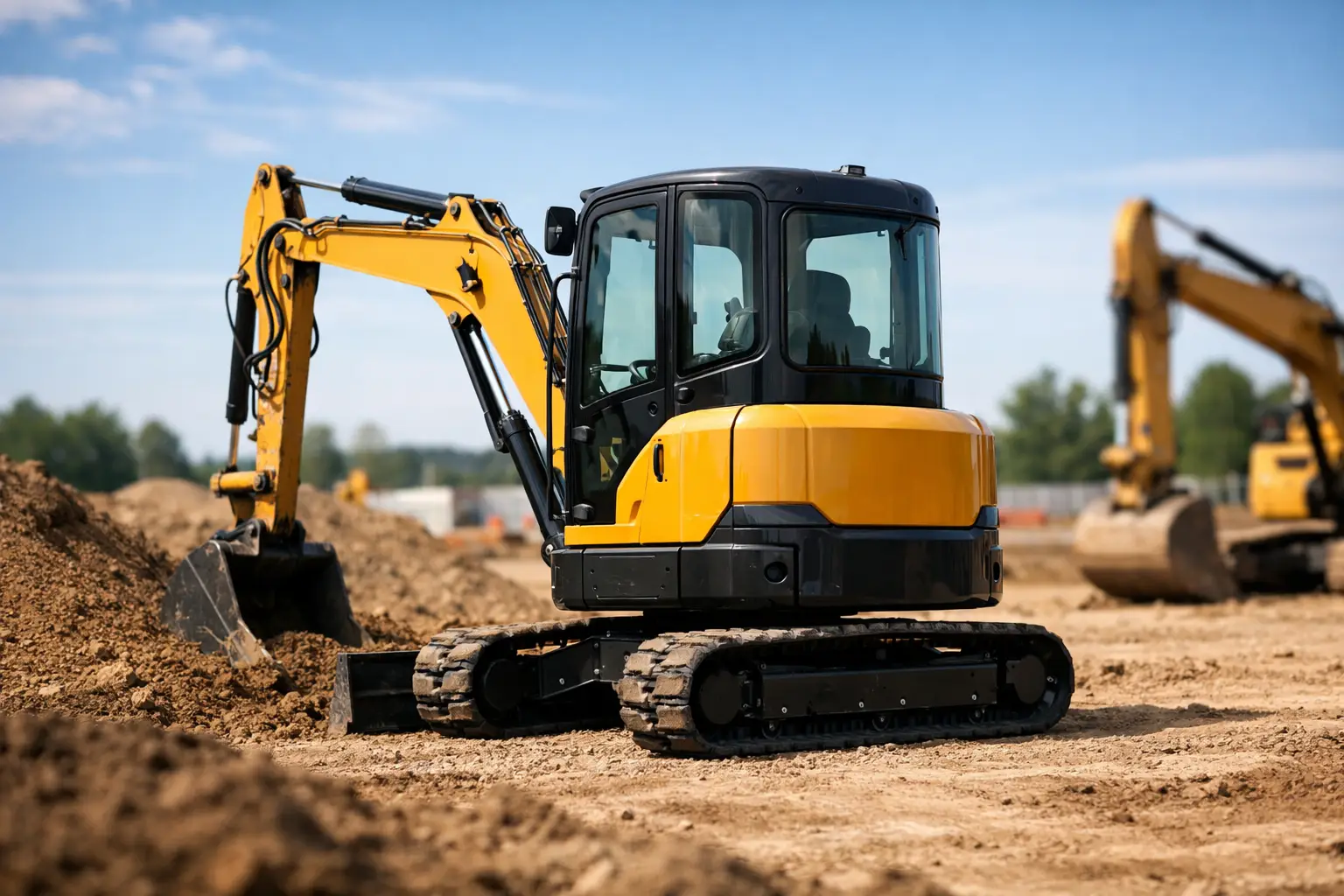
Zero tail swing describes an excavator design in which the rear of the upper structure stays within the width of its tracks as the house rotates. Put simply, when the operator swings the machine, the counterweight does not extend beyond the track footprint at the rear. That reduced swing radius gives crews more room to work close to walls, fences, parked vehicles, traffic barriers, and other jobsite obstacles.
What Does Zero Tail Swing Mean for Excavator Operation?
A mini excavator has two main sections: the undercarriage, which includes the tracks and blade, and the upper structure, which carries the cab, engine, hydraulic system, boom, and counterweight. The upper structure rotates 360 degrees while the tracks remain in place.
On a conventional tail swing excavator, the counterweight projects past the tracks when the upper structure turns. That is not a problem on an open site, but it requires clearance behind the machine. If the operator swings too close to a wall, parked truck, building corner, or live traffic lane, the counterweight can strike it.
A zero tail swing excavator is built to keep that rear counterweight inside the track width during rotation. The operator can swing the house in tighter quarters without the rear end sweeping into an obstruction. This is especially valuable when loading spoil into a truck from a narrow roadside trench or rotating between a dig area and a pile in a confined backyard.
The term applies to the rear swing profile, not the complete working envelope. The boom, arm, bucket, and any attachment can still extend well beyond the tracks. Operators still need to account for the front and side reach of the attachment, the machine’s blade position, ground conditions, and people working nearby.
Why Zero Tail Swing Matters on Tight Jobsites
The biggest advantage is clearance. A compact excavator can work closer to fixed objects because it needs less room behind the cab to rotate. Instead of constantly tracking forward and backward to create swing room, the operator can often stay positioned near the work and complete more cycles from one location.
That can improve production on trenching, utility installation, drainage work, foundation repairs, demolition cleanup, and residential landscaping. Fewer repositioning moves can reduce cycle time, limit track wear, and help keep a crew moving through the work area.
Zero tail swing also supports safer operation, particularly on sites where space is shared with workers, pedestrians, structures, or traffic. Keeping the rear of the machine inside the tracks reduces one predictable strike zone during rotation. It does not replace a proper exclusion zone, spotter, or operator awareness, but it gives the operator more margin around close obstructions.
For contractors working in Jacksonville and across Northeast Florida, confined conditions are common. Established neighborhoods, coastal properties, commercial retrofits, utility corridors, and landscaped sites often leave little room for equipment. A zero tail swing mini excavator can make those jobs more practical without moving up to a larger work area or relying on excessive hand labor.
Zero Tail Swing vs. Conventional Tail Swing
Neither configuration is automatically better. The right choice depends on the work, required lift capacity, dig depth, attachment plan, and available space.
A conventional tail swing excavator generally has more rear counterweight extending behind the tracks. That counterweight can help balance the machine, particularly during heavier lifting or longer-reach digging. On open sites with room to swing, conventional designs can be a strong fit for production excavation, site development, agricultural work, and repetitive loading.
A zero tail swing machine puts a priority on compact rotation. The counterweight and internal components are packaged to protect the rear clearance profile. That makes it a practical choice for jobs where walls, curbs, buildings, fences, and traffic control devices limit the operator’s swing area.
There is also a middle ground. Reduced tail swing, sometimes called tight tail swing, means the rear overhang is smaller than a conventional machine but may still extend beyond the tracks. It can offer a useful compromise for contractors who need a compact swing radius but want a different balance of machine size, stability, or performance.
The labels are useful, but buyers should compare the actual specifications for each model. Track width, tail radius, transport dimensions, operating weight, lift charts, hydraulic flow, and maximum digging depth all affect how a machine performs in the field.
What Zero Tail Swing Does Not Mean
Zero tail swing is frequently misunderstood as a guarantee that an excavator can rotate anywhere without clearance concerns. It does not mean that.
The rear of the upper structure may stay inside the track width, but the track frame itself still has width. The dozer blade can extend forward, and the boom can swing or travel outside the machine footprint. A bucket loaded with wet clay, broken concrete, or rock changes the working envelope and requires additional control.
It also does not mean every zero tail swing excavator has identical stability or lifting performance. Operating weight, undercarriage length, track stance, hydraulic capability, boom configuration, and counterweight design all matter. A compact machine should always be evaluated against the expected load, lift radius, and ground conditions.
Manufacturers can also use similar terms differently. Confirm the published tail swing dimensions rather than assuming the name alone tells the whole story. If a job has inches of clearance around a structure, measure the actual work zone and compare it with the machine’s transport width, swing dimensions, and attachment profile.
Where a Zero Tail Swing Excavator Fits Best
Zero tail swing machines earn their keep where access and maneuverability directly affect production. They are well suited to residential excavation, drainage installation, pool and patio work, trenching alongside structures, utility repairs, sidewalk replacement, cemetery work, and interior demolition where equipment access allows.
They also make sense for municipal and roadside crews. When a machine must work beside barriers, curbs, parked vehicles, or an active travel lane, reducing rear overhang can help preserve a workable operating area. Rental operators may also favor the configuration because it serves a broad range of compact-site applications.
That said, an open-site contractor should not select zero tail swing solely because it sounds more compact. If the work calls for frequent heavy lifting, maximum reach, or high-volume truck loading, a conventional or reduced-tail-swing excavator may better match the duty cycle. The productive machine is the one that fits both the space and the work.
How to Choose the Right Zero Tail Swing Machine
Start with the site, not the model name. Measure gates, side yards, alleys, truck access, trench offsets, and the clearance around structures. Consider how the machine will enter, turn, stage spoil, and load out material. A narrow access route may point toward a smaller machine, but the required digging depth or lift capacity may call for more operating weight.
Then match the excavator to the tools it will run. A trenching bucket, grading bucket, hydraulic breaker, auger, grapple, or compaction wheel changes the demands on hydraulic flow, auxiliary connections, and machine stability. Attachment capability is part of the buying decision, not an afterthought.
Operator comfort also affects output over a full shift. Clear visibility, intuitive controls, climate protection, smooth hydraulics, and a stable work platform help an operator work accurately around structures and utilities. On compact sites, precision matters as much as raw digging force.
BRIGGS | JCB offers compact excavator options for crews that need to work productively where space is limited, including zero tailswing configurations such as the compact JCB 18Z-1. Comparing a machine’s operating weight, dig depth, dump height, hydraulic performance, and tail swing design gives buyers a clearer picture than any single feature alone.
A zero tail swing excavator will not make a tight jobsite wide open. It gives a skilled operator more usable room to rotate, load, and dig without putting the counterweight outside the tracks. When clearance is the constraint, that extra room can keep the job moving.