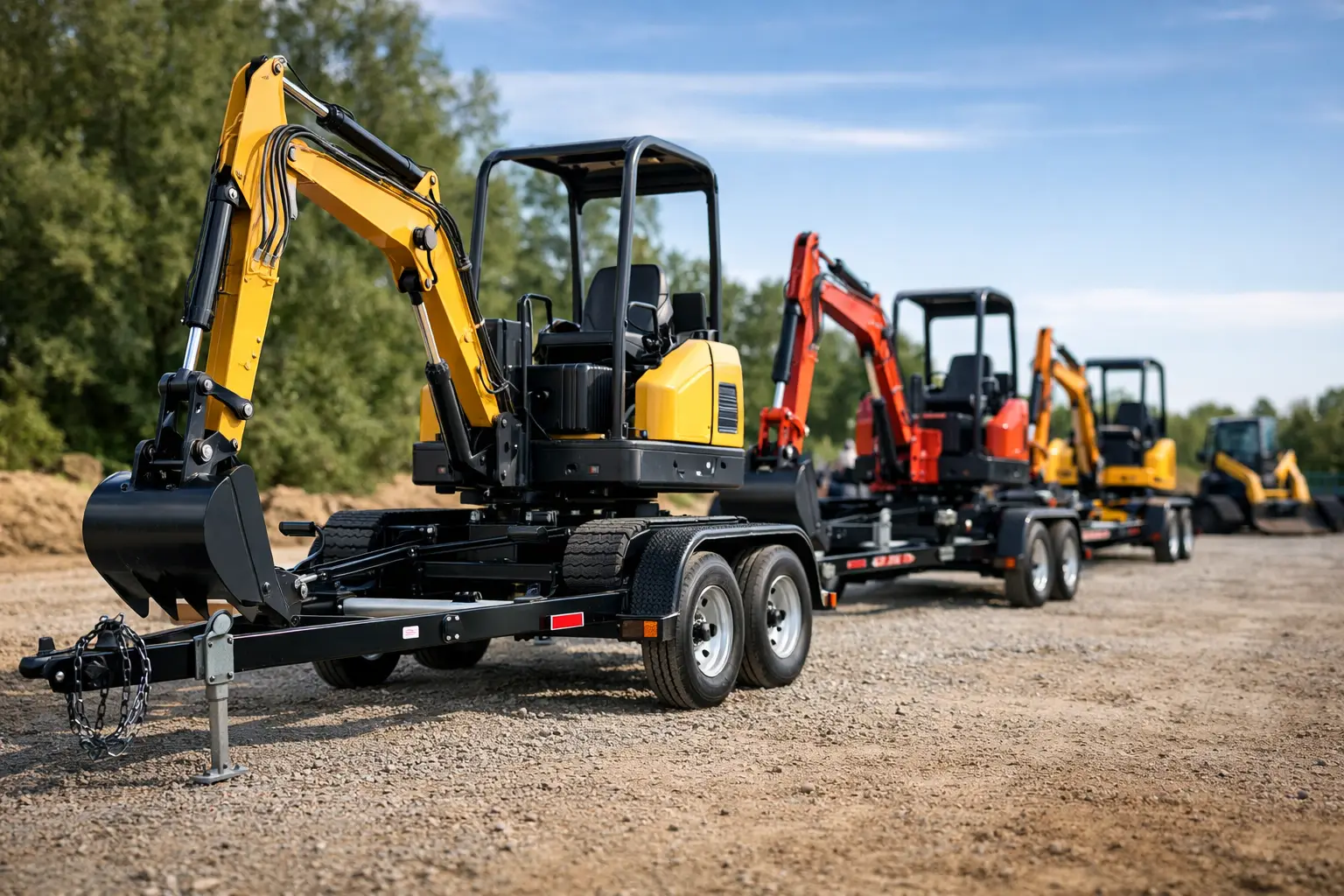
A compact excavator only saves time if it can arrive at the job without creating a transport problem. The best towable excavators for contractors balance productive digging performance with a realistic trailer, truck, and licensing plan. For Jacksonville contractors, that often means choosing a machine that can move between residential sites, utility repairs, drainage work, and commercial projects without tying up a heavy-haul truck.
Towable does not mean the excavator’s operating weight alone fits behind a pickup. The real question is whether the complete transport package works: excavator, attachments, trailer, fuel, ramps, chains, and the tow vehicle’s rated capacity. A 3,600-pound machine may be easy to move, while a larger compact excavator can still be towable with the right truck and trailer. The best choice depends on the work your crew does most often, not on the largest machine you can pull once in a while.
What Makes an Excavator Towable?
Start with the machine’s operating weight, then add the equipment that travels with it. A hydraulic thumb, bucket selection, auger drive, breaker, quick hitch, and fuel all affect the loaded trailer weight. The trailer itself can add several thousand pounds before the excavator is loaded. That total must remain within the trailer’s GVWR, the truck’s towing rating, receiver and hitch limits, axle ratings, and applicable federal and Florida requirements.
Transport length and width matter, too. A compact machine that fits securely on a standard equipment trailer can be dispatched quickly. A wider or heavier machine may need a larger deck-over trailer, more towing capacity, and more room for loading at the yard or on site. That is not automatically a bad trade. It simply means transport needs to be part of the buying decision.
For many owner-operators, the practical sweet spot is a machine under roughly 10,000 pounds operating weight, paired with a properly rated trailer and truck. Contractors with recurring deep utility work, demolition, or production excavation may get more value from a larger machine, even if it requires a heavier transport setup.
7 Best Towable Excavators for Contractors
The following JCB compact excavators cover the towing and production range most contractors consider. These are not interchangeable machines. Each earns its place based on the type of work, access conditions, and transport resources behind it.
1. JCB 18Z-1 for tight access and light transport
At 3,649 pounds operating weight, the JCB 18Z-1 is a strong option for contractors who need a compact machine that is straightforward to transport. Its zero-tailswing design is built for working beside foundations, fences, road edges, and other confined obstacles where a conventional counterweight can become a liability.
This is a practical excavator for landscape contractors, small utility crews, pool builders, and owner-operators handling trenching, drainage, cleanup, and light demolition. The trade-off is production capacity. When the job calls for repeated deep cuts, large trench boxes, or heavy material handling, moving up in size can reduce cycle times.
2. JCB 19C-1 for daily contractor versatility
The JCB 19C-1 adds a more substantial working platform while staying within the compact, trailer-friendly class many small contractors prefer. It suits crews that need more than occasional digging power but still work in backyards, urban infill sites, and established commercial properties.
For a contractor purchasing one excavator to cover many assignments, this size is worth close attention. It can take on trenching, grading, loading, and attachment work without bringing the transport demands of a mid-size compact excavator. Confirm the loaded trailer weight before selecting the truck, especially if a thumb and multiple buckets stay with the machine.
3. JCB 35Z-1 for zero-tailswing production
The JCB 35Z-1 is a productive step up for contractors who need a stronger dig-and-load machine without giving up the benefits of zero tailswing. It is well suited to utility installation, residential sitework, septic work, and commercial landscaping where the excavator must work close to walls, traffic control, or stored materials.
This is where towing decisions become more specific. A machine in this class may require a heavier equipment trailer and a properly equipped three-quarter-ton or one-ton truck, depending on the complete package. It offers more capability than the smallest minis, but it should not be matched to a trailer based only on a brochure weight.
4. JCB 48Z-1 for work around fixed obstacles
The JCB 48Z-1 fits contractors who need greater reach, lift capability, and digging output while regularly working in restricted areas. Zero tailswing helps reduce strike risk when swinging spoil, loading trucks, or operating next to structures. That advantage matters on crowded Florida jobsites where space is often limited by property lines, utilities, and existing buildings.
It can be towable for contractors with the right truck and trailer combination, but it is no longer a casual pickup-and-trailer decision. This machine makes sense when its increased production will be used consistently. If it spends most days digging shallow landscape trenches, a smaller model may deliver a better cost-per-hour result.
5. JCB 55Z-1 for heavier attachments and sitework
For crews using hydraulic thumbs, breakers, augers, or larger buckets on a regular basis, the JCB 55Z-1 brings more working capacity to demanding compact jobs. It is a strong fit for demolition support, land clearing, drainage installation, and material handling where a smaller excavator can become underpowered or unstable.
Transport remains possible for properly equipped fleets, but this size calls for careful planning. The truck, trailer, tie-down points, brake controller, and payload limits all need to match the job. Contractors should also consider whether attachments will ride on the trailer or travel separately. A breaker or auger can change the numbers quickly.
6. JCB 67C-1 for serious utility and excavation work
The JCB 67C-1 is for contractors whose work has outgrown the smallest compact class. Its conventional tailswing configuration can provide the stability and working performance crews want for sustained trenching, loading, and excavation. It is a capable machine for site-development and utility contractors who need more than occasional production digging.
Calling it towable is appropriate only when the fleet has the transport capacity to support it. This is generally a heavier trailer and truck conversation, not a light-duty pickup conversation. The payoff is fewer compromises on demanding work, particularly when soil conditions, trench depth, or daily material movement require more machine.
7. JCB 86C-2 for high-output compact excavation
The JCB 86C-2 is a contractor-grade choice for crews that need substantial compact-excavator performance while still valuing jobsite maneuverability. It belongs in the discussion when production, reach, lift, and attachment capability carry more weight than quick transport behind a standard pickup.
For many fleets, this machine is transportable rather than conveniently towable. That distinction matters. If it will remain on a multi-week project or move between major jobs on a dedicated trailer, its output can justify the transport requirement. If it must make several short moves every week, a 35Z-1 or 48Z-1 may keep the operation more efficient.
Match the Machine to the Work Before the Trailer
The right buying sequence is job requirements first, transport second, and model selection third. Identify the trench depth, loading height, lift requirements, access width, attachment needs, and hours the machine will work each week. Then calculate the complete transport weight and confirm the truck-trailer combination can safely carry it.
Before every move, operators should verify five basics:
- The trailer GVWR, axle ratings, tires, brakes, ramps, and deck capacity match the loaded machine.
- The tow vehicle is rated for the actual loaded trailer weight, not just the excavator’s operating weight.
- Buckets and attachments are secured, the boom is positioned for transport, and the load is balanced over the trailer axles.
- Proper tie-downs are used at the designated machine points, with chains and binders sized and inspected for the load.
- Width, lighting, brake controller operation, licensing, and route conditions have been checked before the truck leaves the yard.
Zero Tailswing or Conventional Tailswing?
For towable excavators, tailswing affects jobsite productivity more than transport. Zero-tailswing models such as the 18Z-1, 35Z-1, and 48Z-1 are valuable when operators work against walls, in residential yards, or near live traffic. They allow the upper structure to rotate with less risk of swinging into an obstacle.
Conventional-tailswing machines can be a better fit where there is room to work and the priority is stable, sustained excavation. Utility corridors, open site-development work, and agricultural applications may favor that design. The best configuration is the one that lets the operator work safely without constantly repositioning the machine.
A productive excavator is not merely the biggest one on the trailer. It is the machine that reaches the site safely, fits the work area, handles the attachment plan, and keeps the crew moving through the next job. BRIGGS | JCB can help contractors compare the JCB range against the transport setup and field demands they already have.