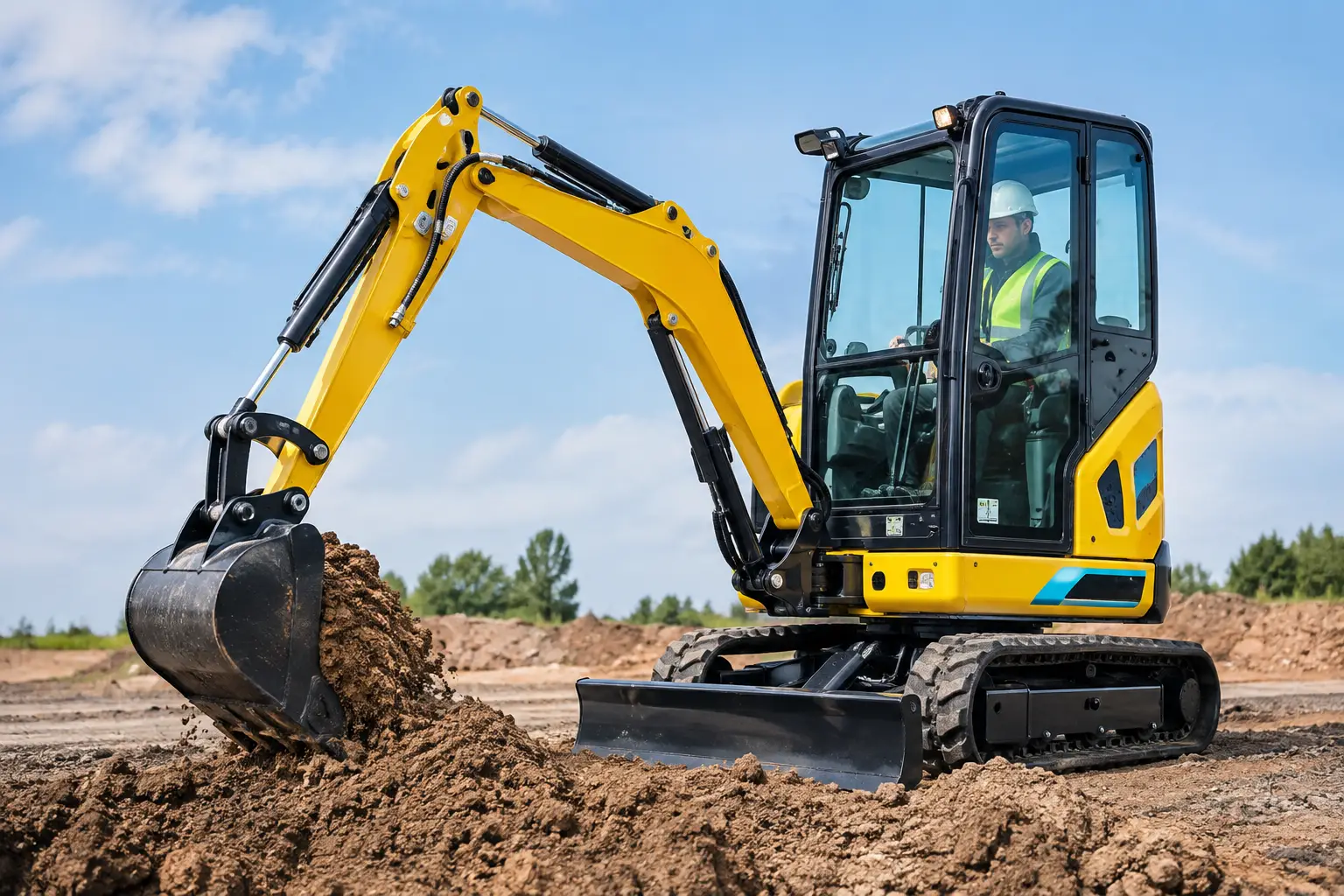
A utility trench inside a finished facility, a downtown repair beside occupied offices, or a night shift near residential homes can turn engine noise and exhaust into real production limits. This JCB 19C-1E electric excavator guide is built for contractors who need a compact digging machine that can work where diesel equipment is restricted, disruptive, or simply not the best fit.
The 19C-1E is not an electric machine chosen only for appearances. It is a 1.9-ton-class compact excavator designed to perform the daily digging, trenching, grading, and cleanup work expected from a mini excavator while producing zero emissions at the point of use. For the right crews, that changes which jobs can be completed with one machine – and when they can be completed.
What the JCB 19C-1E Is Built to Do
The JCB 19C-1E is a compact electric excavator for work where access, noise control, indoor air quality, and maneuverability matter as much as digging performance. Its conventional tailswing layout gives the machine a stable working stance and helps support strong lift and breakout performance for its size. It is a practical fit for utility contractors, municipalities, landscapers, demolition crews, site contractors, and rental fleets that regularly encounter confined or sensitive work areas.
Typical applications include interior demolition, basement and parking-garage work, utility repairs, landscaping near occupied buildings, cemetery work, schools, hospitals, municipal maintenance, and projects with noise-hour restrictions. The absence of diesel exhaust is especially valuable in enclosed spaces, but the lower noise level can matter just as much outdoors. Operators can communicate more easily with spotters and ground crews, and work can continue closer to tenants, patients, students, or neighbors.
That does not mean electric power is the right answer for every excavation job. If a crew spends long days far from reliable power, runs high-demand attachments continuously, or needs to move a machine between several remote sites without planned charging time, a diesel mini excavator may remain the better production choice. The key is matching the power source to the work cycle.
JCB 19C-1E Electric Excavator Guide: Key Buying Factors
A purchase decision should start with the jobsite, not with the fact that the machine is electric. The 19C-1E earns its place when its operating profile matches the work your crew performs repeatedly.
Runtime is about the work cycle
Battery runtime is not a single fixed number. It changes with digging conditions, operator technique, travel distance, idle time, ambient temperature, and attachment use. A machine trenching in soft material with normal pauses works differently than one repeatedly loading dense material, running a hydraulic breaker, or tracking across a large site.
For many light-to-medium-duty compact excavator applications, the 19C-1E can cover a productive shift segment before charging. Contractors should plan around their actual duty cycle rather than assume an all-day result from a published runtime figure. Track a typical day: how many hours are spent actively digging, how often the machine sits while crews set pipe or check grade, and whether a planned break can become a charging window.
Electric equipment works best when charging is treated as part of the daily operating plan. A crew with access to suitable power at a yard, facility, job trailer, or overnight storage location has a much easier path than a crew relying on uncertain temporary power.
Charging access needs to be decided before delivery
The 19C-1E uses a lithium-ion battery system and can be charged from appropriate available power sources. The charging approach affects both operating flexibility and project scheduling. Faster charging can reduce downtime, while lower-power charging may be practical when the machine is parked overnight.
Before buying, identify where the excavator will be stored and charged. Confirm electrical service, outlet type, cable routing, site security, and whether the charging location remains available as the project progresses. On commercial sites, this discussion should include the general contractor early. On municipal or facility work, verify who controls access to power and whether charging is permitted after hours.
Do not treat charging as an afterthought. A clean charging plan is what turns an electric excavator from a specialty machine into a dependable production asset.
Compact size still has to match the trench and truck
The 19C-1E brings mini-excavator maneuverability to tight jobs, but buyers should still compare working dimensions, digging depth, reach, dump height, and lift requirements against the material and site plan. A machine that fits through an access gate but cannot safely place pipe, load the intended truck, or reach the required trench depth is not the right fit.
Transport is another practical advantage. A compact excavator in this class can often be moved with a properly matched trailer and tow vehicle, helping owner-operators and smaller crews avoid a larger hauling setup. Verify the total transport package, including the trailer, bucket, coupler, attachments, fuel-free machine weight, tie-down equipment, and tow vehicle ratings. Safe transport capacity matters more than a rough estimate.
Hydraulics and attachments determine the machine’s value
A compact excavator becomes more useful when it can move quickly between tasks. Bucket selection should match the work: a narrow trenching bucket for utilities, a wider bucket for cleanup and grading, or a ditching bucket for shaping slopes. Coupler configuration, auxiliary hydraulic requirements, and attachment weight all need to be considered before purchase.
The 19C-1E can be a strong machine for light demolition and controlled material handling, but attachment demand affects runtime. A breaker, grapple, auger, or other hydraulic tool may be a smart addition if it replaces manual labor or another machine, but it changes the battery and productivity calculation. Ask for the expected performance based on the attachment and material your crew handles most often.
Where Electric Power Pays Off
The operating-cost case for an electric excavator is not limited to energy expense. Electric power eliminates diesel fill-ups, reduces routine engine-related service items, and removes exhaust aftertreatment concerns from the equation. Those benefits are meaningful, but they should be measured against the charging infrastructure and utilization pattern required by your business.
The larger payoff can come from access. If electric power allows your crew to work inside a building without a separate ventilation plan, operate during noise-sensitive hours, or win a facility project that limits combustion equipment, the machine may create revenue opportunities a diesel unit cannot address as easily.
Consider a contractor performing interior renovation work. A diesel excavator may require open doors, airflow management, idle restrictions, and added coordination with other trades. The 19C-1E reduces those obstacles. On a municipal project near homes, quieter operation may allow more productive work windows. On a landscaping project at an active campus, reduced noise and no tailpipe emissions can make the crew less disruptive to daily operations.
Those gains depend on the project mix. A contractor focused on open land clearing or remote site development may get more value from a conventional diesel fleet. A contractor serving facilities, utilities, municipalities, and dense commercial properties may find electric equipment becomes a frequent first-choice machine.
Operator Comfort and Jobsite Safety
Productivity depends on an operator who can work accurately for the full shift. The 19C-1E provides the compact visibility and control expected in a JCB mini excavator, while electric operation reduces engine noise and vibration. Less noise does not remove the need for jobsite discipline. In fact, quieter equipment makes it even more important to establish exclusion zones, use a spotter when visibility is limited, and keep ground personnel clear of the swing area and attachment.
Daily inspections remain essential. Check tracks, undercarriage components, bucket pins, hoses, guards, controls, lights, and safety systems. Inspect the charging cable and connector before use, and follow the manufacturer’s instructions for battery charging, storage, and service. The high-voltage system is not a field repair item. Any battery or electrical concern should be handled by trained personnel.
For fleet managers, operator orientation should cover more than the controls. Crews need to understand charging responsibilities, parking procedures, how attachment use affects battery consumption, and what to do if a job runs longer than expected. Clear habits prevent a machine from arriving at the next shift without the charge it needs.
Questions to Ask Before You Request a Quote
The best equipment quote is based on the work, not just the machine price. Be ready to discuss your primary application, required digging depth, typical material, attachment plan, access restrictions, towing setup, expected daily hours, and available charging power. If the machine will work indoors, share doorway dimensions, floor conditions, ventilation limitations, and any site rules governing equipment.
It also helps to compare the 19C-1E with a diesel mini excavator of similar size. The comparison should cover purchase price, charging or fuel costs, maintenance expectations, available incentives where applicable, planned annual hours, and the type of work you may gain or retain by using electric power. There is no universal winner. The better machine is the one that keeps your crew productive with the fewest operational compromises.
For Northeast Florida contractors considering an electric compact excavator, BRIGGS | JCB can help evaluate machine configuration, attachment needs, transport requirements, and the charging plan behind the purchase. A quote conversation should produce more than a number – it should confirm that the excavator can earn its place on the schedule.
The JCB 19C-1E makes the most sense when its quiet operation and zero-emission-at-point-of-use capability solve a jobsite problem your crew faces often. Put it to work where those advantages protect access, improve working conditions, and keep the job moving.