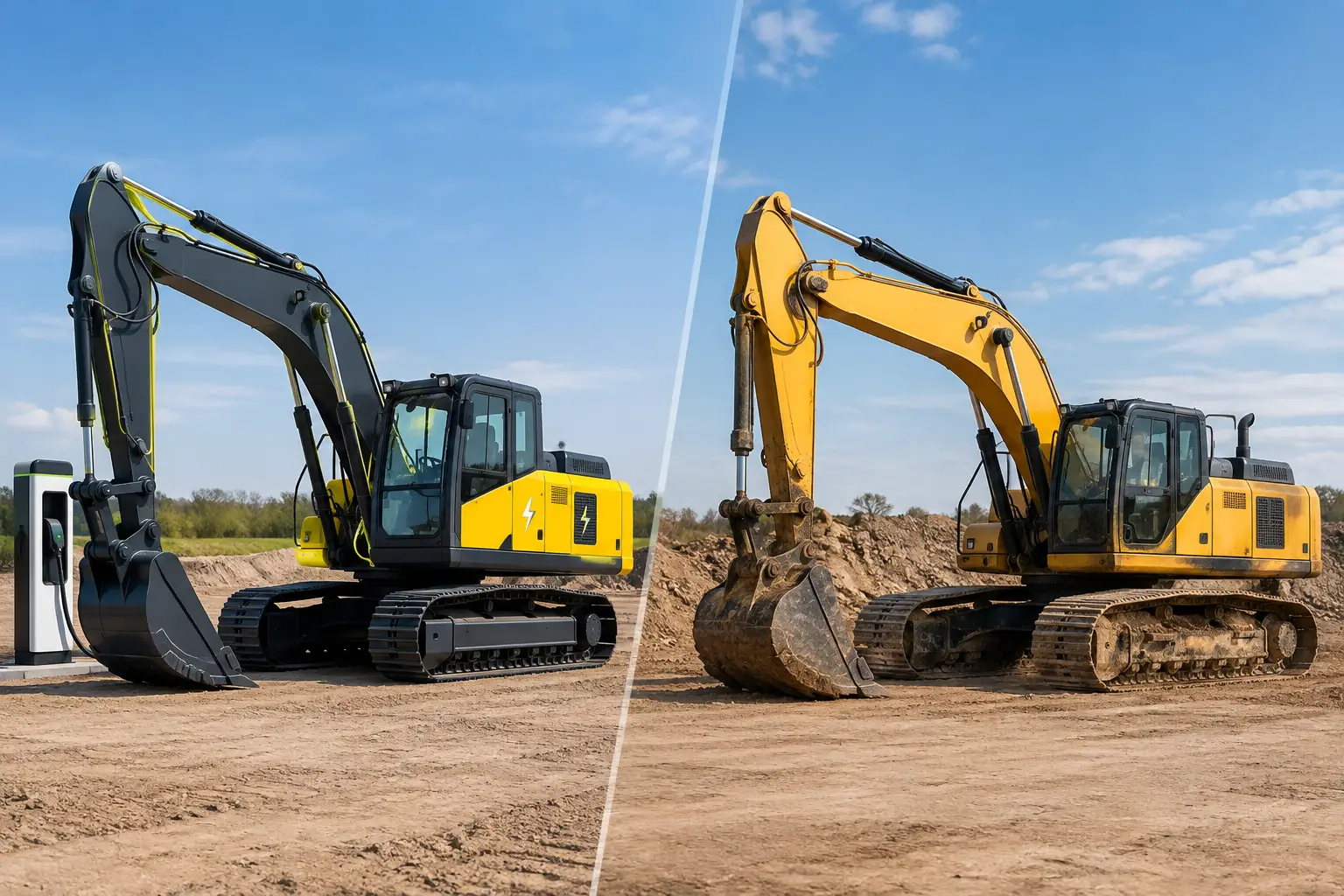
A compact excavator may spend its day trenching beside a hospital, breaking out concrete behind a retail center, or cutting drainage on an undeveloped site. Those are very different operating environments, and the electric vs diesel excavator decision comes down to more than engine type. The right machine has to match the work, the access, the duty cycle, and the conditions that affect your crew’s production.
Electric mini excavators bring quiet operation and zero tailpipe emissions to sites where diesel exhaust or noise creates a real restriction. Diesel excavators remain the proven choice for long shifts, remote work, and demanding applications where fast refueling and sustained performance matter most. Neither is automatically the better machine. The better choice is the one that keeps the job moving without adding avoidable cost or downtime.
Electric vs Diesel Excavator: The Jobsite Difference
The first question is not whether electric equipment is newer technology or whether diesel is more familiar. Ask what the jobsite will allow. An electric excavator can be a strong fit for enclosed or partially enclosed areas, occupied properties, urban work zones, schools, hospitals, and overnight projects where noise limits are tight. With no diesel exhaust at the point of use, crews can work closer to buildings and people with fewer ventilation concerns.
Diesel is built for the broadest range of field conditions. Utility crews working along a right-of-way, site-development contractors opening up new ground, and agricultural operators maintaining ditches or handling material often need a machine that can run far from reliable electrical infrastructure. A diesel excavator can be refueled quickly in the field and returned to work, which is valuable when every hour of daylight is part of the production plan.
For many contractors, the decision is driven by where the machine spends most of its time, not by one occasional project. A fleet that regularly works inside buildings or on noise-sensitive municipal sites may gain an advantage from electric. A fleet moving between rural utility work, land clearing, drainage, and general excavation will often get more consistent use from diesel.
Power, Digging Force, and Daily Production
Electric excavators deliver torque immediately. That responsive power can be especially useful when feathering controls for finish work, trenching around utilities, or working in tight quarters. Operators also benefit from a noticeably quieter work area, making it easier to communicate with spotters and ground crews without constantly raising their voices.
That does not mean an electric compact excavator is a substitute for every diesel model on every task. Buyers should compare the actual specifications that affect production: operating weight, bucket breakout force, arm force, digging depth, reach, hydraulic flow, lift capacity, and auxiliary hydraulic performance. A machine that handles a grading bucket well may not have the hydraulic capacity or operating weight needed to run a demanding attachment all day.
Diesel machines have a long record of handling extended, variable workloads. When the plan includes deep trenching in hard ground, loading trucks, moving between tasks, or running hydraulic attachments for a full shift, diesel fuel capacity and field refueling can be major advantages. This is particularly true on jobs where an idle machine creates delays for an entire crew.
Machine size still matters as much as power source. A smaller zero-tailswing excavator can work where a larger conventional-tailswing machine cannot safely turn. Before choosing electric or diesel, confirm the access width, transport plan, dig depth, tail swing clearance, and attachment requirements. A power source cannot make up for buying the wrong operating weight class.
Runtime and Refueling Strategy
Runtime is one of the clearest differences between electric and diesel excavators. Diesel supports long operating days as long as fuel is available. A fuel truck, onsite tank, or service pickup can keep a diesel fleet productive with minimal interruption, even when the job is miles from the nearest utility connection.
Electric runtime depends on battery capacity, work intensity, ambient temperature, attachment use, and charging access. Light-duty excavation, landscaping, finish grading, or intermittent trenching may allow a machine to cover a planned shift. Continuous heavy digging or attachment work will draw more energy. Buyers should plan from real duty cycles, not an idealized runtime number.
Charging must be treated as part of the operating plan. If a crew can charge overnight at a secured yard and work predictable daytime shifts, electric equipment may fit cleanly into the schedule. If the machine needs to rotate between jobs, work overtime, or operate where power is uncertain, charging logistics deserve a hard look before purchase.
Consider the full workflow. Is there adequate electrical service at the yard? Who is responsible for connecting and monitoring charging? Is the machine transported every day? Can it be charged during planned breaks? These questions are operational details, not paperwork. They determine whether an electric excavator creates an advantage or a scheduling problem.
Operating Costs Go Beyond Fuel
Electric equipment can reduce routine engine-related maintenance. There are no engine oil changes, diesel fuel filters, exhaust aftertreatment components, or emissions-system service items associated with a conventional diesel engine. For an operation that uses a machine frequently in controlled environments, those maintenance differences can improve cost predictability.
Electricity cost should still be evaluated against local rates, charging equipment needs, and the equipment’s actual energy use. Battery condition and warranty coverage should be part of the ownership conversation as well. The lowest daily energy cost does not automatically mean the lowest long-term ownership cost if the machine’s utilization does not justify its purchase price or charging setup.
Diesel maintenance is familiar to most contractors and service teams. Fuel, filters, fluids, inspections, and scheduled maintenance are straightforward parts of fleet management. Diesel also has the advantage of an established service and fueling routine across most commercial jobsites. For a company that already has mobile fuel support and diesel technicians, adding another diesel compact excavator may be the simplest operating decision.
When comparing costs, look at utilization instead of focusing only on purchase price. Calculate expected annual hours, fuel or energy consumption, scheduled maintenance, transport, operator downtime, and the value of working on sites where emissions or noise restrictions would otherwise limit access. The machine that costs less to own is the one that stays productive in its assigned role.
Noise, Emissions, and Operator Comfort
Electric excavators are quiet enough to change how a site feels. Lower noise can help crews work near residences, businesses, schools, and public spaces with less disruption. It can also improve communication around the machine, although normal jobsite safety procedures, exclusion zones, and spotter practices still apply.
Zero tailpipe emissions are most valuable where ventilation is limited or air quality is closely managed. Interior demolition, parking structures, greenhouses, warehouses, and work near occupied buildings are common examples. Electric equipment can help contractors meet site rules without relying on additional ventilation measures for diesel exhaust.
Diesel equipment remains practical for open-air work where ventilation and noise are not limiting factors. Modern compact excavators are designed with operator comfort, visibility, and controllability in mind, and a properly sized diesel machine can be highly productive in tight spaces. For both power types, cab or canopy configuration, control layout, visibility, seat comfort, and ease of daily checks affect the operator’s ability to produce safely over a full shift.
Choosing the Right Compact Excavator
An electric excavator makes the most sense when quiet operation, zero tailpipe emissions, and planned charging directly support the work. It is a strong option for indoor construction, sensitive properties, municipal work, and repetitive projects that return to a charging location.
A diesel excavator makes the most sense when long runtime, remote access, rapid refueling, and broad task flexibility are the priority. It remains the dependable workhorse for site development, utility installation, agriculture, demolition, and general excavation across changing locations.
At BRIGGS | JCB, the right discussion starts with the job details: required dig depth, operating weight, tail swing, attachment use, transport limits, shift length, and site restrictions. Those details narrow the field faster than a simple electric-versus-diesel label ever will.
Choose the machine around the work your crew performs week after week. If it can work the full planned shift, fit the site safely, and keep the operator productive without creating a fueling or charging bottleneck, it is built for the job.